September 30, 2026 · Modality
Post-Event Follow-Up: Turn Attendees Into Regulars
The money in events is in the follow-up. Here is the post-event sequence that thanks attendees, gathers feedback, and books them for the next one.
A post event follow up email is how you turn a one-time attendee into a regular, and it is the single most skipped step in running events. The move is simple: send a genuine thank-you within a day, ask one feedback question, then invite people to the next thing. Do that consistently and your hardest-won audience, the people who already showed up once, starts coming back on its own.
This guide covers why the follow-up matters so much, the exact event follow up sequence and timing, example templates for each message, and how to automate the whole thing so it runs after every event without you lifting a finger. Our running examples are a weekend workshop and a recurring venue night.
Why does the post-event follow-up turn attendees into regulars?
Because the moment right after an event is when goodwill is highest and memory is freshest, and a well-timed post event follow up email captures that energy before it fades. Someone who just had a great night at your venue or left your workshop feeling inspired is primed to come back. Say nothing, and that feeling cools within days. Reach out, and you convert a fleeting good mood into an actual habit.
Attendee retention is also just cheaper. Selling to someone who already came costs a fraction of acquiring a stranger, which is why repeat attendance is one of the clearest signals of a healthy event business. The follow-up is the mechanism that produces it. Yet most producers skip it, usually because the event is over and everyone is exhausted, and the next promotion has already started. That gap is exactly where the opportunity sits.
Think of it this way: you spent real money and effort getting each attendee in the door once. The post-event follow-up is how you protect that investment. Without it, every event starts from zero, and you are perpetually paying to reacquire people who already like you. With it, each event compounds on the last, and your list of proven, repeat buyers grows a little every time. That compounding is the difference between an event business that feels like a treadmill and one that builds momentum.
What is the exact post-event follow-up sequence?
A good event follow up sequence is short. Three messages do almost all the work. Sending more risks annoying people while they still have the wristband in their bag.
- The thank-you (within 24 hours): a warm, human thank-you sent while the event is still fresh. No ask beyond a highlight or a photo. This is the message that cements the good feeling.
- The one feedback question (2 to 3 days after): a single, easy question. Not a survey. One tap or one sentence. High response rates come from low friction.
- The next-event invite (5 to 7 days after): once you have thanked them and heard from them, invite them to what is next. Because you led with gratitude and listening, this invitation lands as a welcome, not a pitch. Point it at a live event page with tickets ready to buy.
The order matters. Thank first, listen second, sell third. Flip it and you look like you only wanted the next sale, which is exactly the impression that kills retention.
What should each post-event email say?
Here are example templates for each message in the sequence. Keep them short and human. A thank you email after event day should read like a person wrote it, not a marketing department.
Message 1: the thank-you
- Subject: "Thank you for coming to [event]."
- Body: A genuine two to three sentence thank-you. Name the event, share one highlight or a photo, and tell them it meant something that they showed up.
- No hard CTA. Maybe a soft "photos are here" link. That is it.
Message 2: the one feedback question
- Subject: "One quick question about [event]."
- Body: One sentence of context, then one question. For a workshop: "What is the one thing you wished we covered more?" For a venue night: "How was the vibe, one to five?"
- CTA: a single reply button or a one-tap rating. Nothing more.
Message 3: the next-event invite
- Subject: "You're invited back: [next event]."
- Body: Reference that they came last time, then present the next event. If you can, give returning guests early access or a small perk.
- CTA: "Save your spot" pointing to the new event page.
How does the timing differ for a workshop versus a recurring venue night?
The three-message shape holds for both, but the spacing and the invite shift based on how often you run events.
The weekend workshop
Workshops are usually one-off or occasional, so the feedback message carries extra weight: it is how you improve the next session and it makes attendees feel heard. Your next-event invite might point to a follow-on workshop, a more advanced session, or a waitlist for the next cohort. Because these run less often, you can stretch the sequence slightly, sending the invite a week or two out when you have the next date locked.
The recurring venue night
A recurring night has a built-in next thing: next week, next month, the same slot. Here the invite is easy and the retention play is rhythm. Your third message can point straight to the next date and offer regulars a standing perk (skip the line, a returning-guest code). Over time the follow-up trains your crowd to treat your night as a fixture on their calendar. That habit loop is the whole game for venues, which we go deeper on in our guide to CRM for venues.
How do you automate the follow-up so it runs after every event?
The reason people skip the follow-up is that doing it by hand, event after event, is tedious. Automation removes that entirely. You build the sequence once and it fires for everyone who attended, every time, no matter how tired you are.
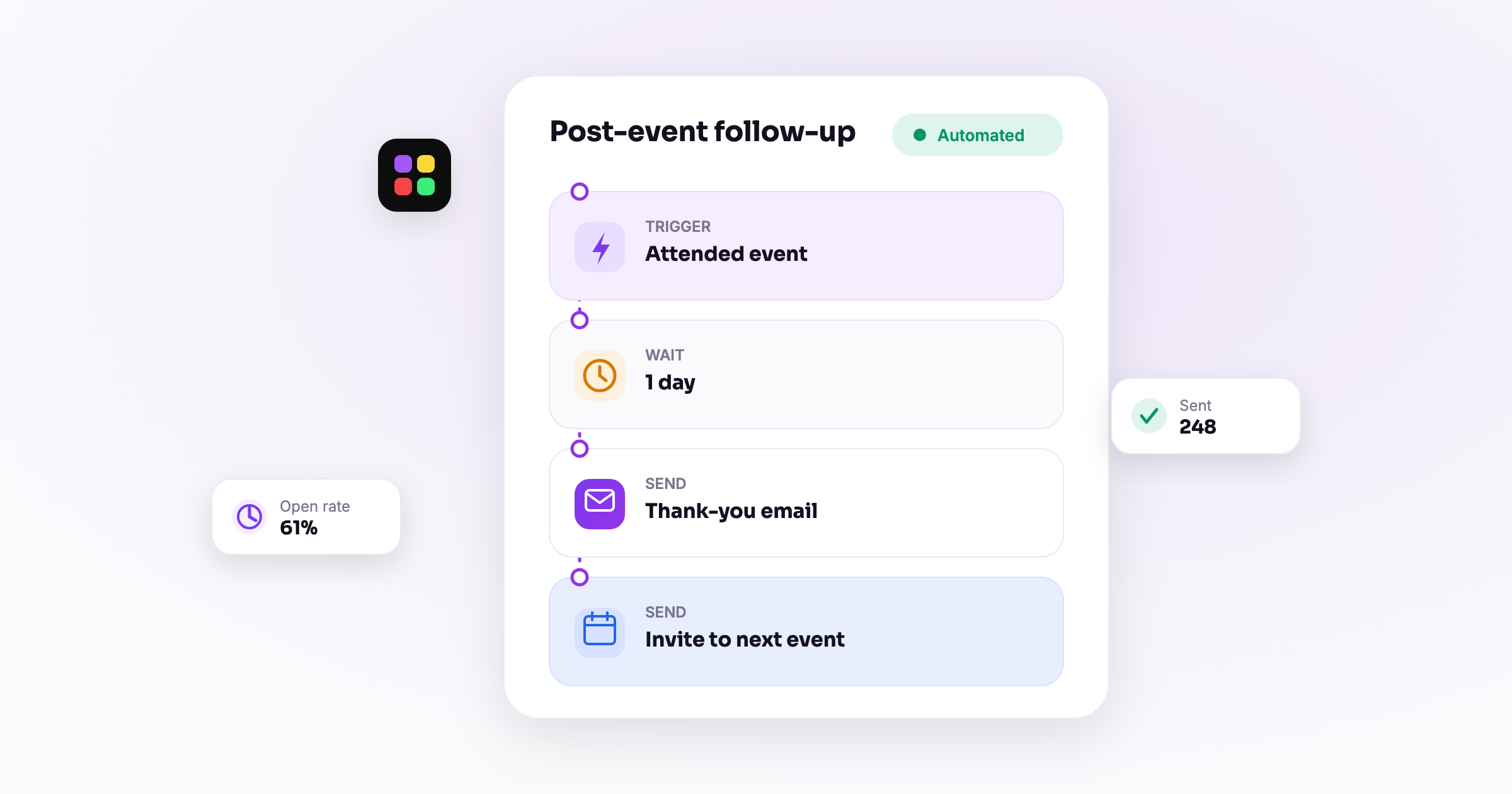
- Trigger on attendance. Set the workflow to start when someone is marked as attended (or when their ticket is scanned in). That becomes day zero for the sequence.
- Set relative timing. Thank-you at plus one day, feedback question at plus three days, next-event invite at plus seven days. The offsets are the same for every event.
- Branch on the feedback. Route unhappy responses to a personal reply and happy ones straight to the invite. A five-star rating and a one-star rating should not get the same next message.
- Reuse it forever. Once built, the same sequence runs after your workshop, your venue night, and everything else, with no manual send.
Modality runs this on its visual automations engine, with 30-plus triggers and 25-plus actions, so "attended an event" kicks off the follow-up flow automatically. Because your attendee data, contacts, and sends all live in one platform, the sequence knows exactly who came and can invite them to the next event without any list-building. Pair the follow-up with the pre-event sends in our event email marketing guide and you have the full loop, announcement to reunion.
Frequently asked questions
When should I send a post-event follow-up email?
Send the thank-you within 24 hours, while the experience is still fresh and goodwill is highest. Follow with a single feedback question two to three days later, then a next-event invite around five to seven days out.
What should a thank you email after an event include?
Keep it short and genuine: name the event, share one highlight or a photo, and thank people for showing up. Skip the hard sell entirely. The thank-you exists to cement a good feeling, not to push the next ticket.
How many emails should a post-event follow up sequence have?
Three is the sweet spot: a thank-you, one feedback question, and a next-event invite. More than that risks fatiguing an audience that just gave you their time, and the extra sends rarely add retention.
How do I automate post-event follow-ups for every event?
Use an automation triggered by attendance, with the three messages set at relative offsets (plus one, plus three, plus seven days). Build it once and it runs after every event automatically, which is the only reliable way to make sure the follow-up actually happens.
Stop letting one-time attendees slip away. Start free with Modality and set up a follow-up sequence that runs after every event, turning first-timers into the regulars who fill your rooms.
Run it all in one place
Modality brings your CRM, ticketing, forms, payments, and marketing together, with AI that sets it up for you.
Start free