July 20, 2026 · Modality
Ticketing Platform Fees Compared: The Real Cost of Selling 60 Tickets
We compared the actual fees on 10 ticketing platforms using a real scenario: 60 tickets at $30. The difference between cheapest and most expensive is $147 per event.
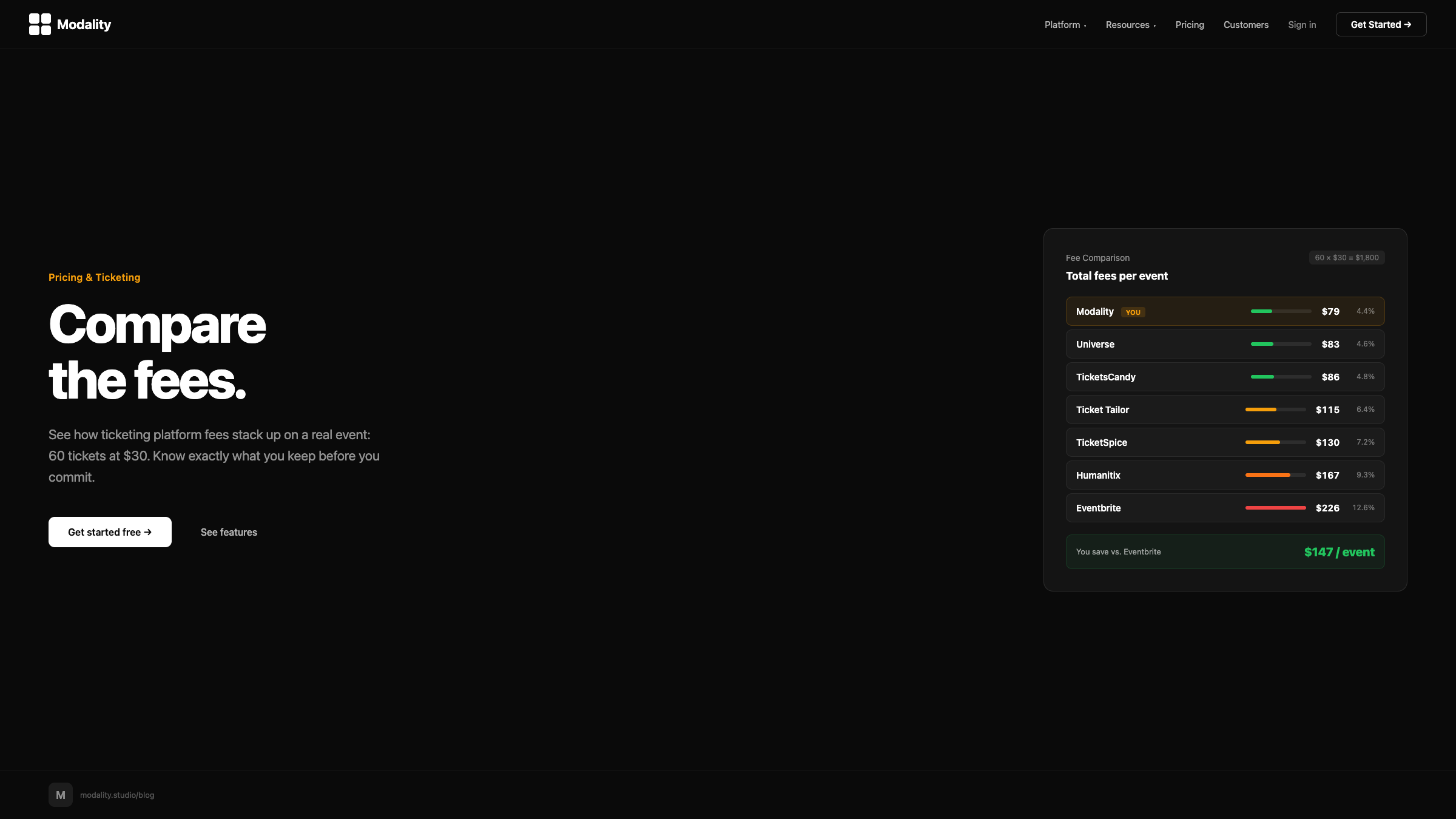
The real cost of a ticketing platform is not always obvious from the pricing page. Some charge a flat fee per ticket, some take a percentage, some bundle payment processing, and some hide the math behind subscription tiers. This guide breaks down the actual fees for 10 popular platforms side by side, using a real scenario: 60 tickets sold at $30 each ($1,800 gross revenue), so you can see exactly what you keep.
If you have been comparing Eventbrite alternatives or shopping for a lower-cost way to sell tickets, the table below will save you hours of digging through pricing pages.
How much do ticketing platforms actually charge?
Every platform charges some combination of three things: a platform or service fee (what you pay them), a payment processing fee (what Stripe, Square, or their processor charges), and sometimes a monthly subscription. The numbers below reflect what you would pay selling 60 tickets at $30 per ticket in the United States, with fees passed to the buyer where possible.
The full comparison: 60 tickets at $30 each ($1,800)
- Modality (Business plan): 0.5% platform + Stripe 2.9% + $0.30. Total fees: $79.20 (4.4%). The Free plan is 1.9% and Pro is 0.9% — both still below most platforms. No subscription required to sell tickets.
- Universe (Starter): 2% + $0.79 per ticket, processing included. Total fees: $83.40 (4.6%). No subscription.
- TicketsCandy: 0.9% platform + Square 2.9% + $0.30. Total fees: $86.40 (4.8%). No subscription.
- Ticket Tailor (prepaid credits): $0.28 per ticket + Stripe 2.9% + $0.30. Total fees: $87.00 (4.8%). Requires buying credit packs upfront.
- Ticket Tailor (pay as you go): $0.75 per ticket + Stripe 2.9% + $0.30. Total fees: $115.20 (6.4%).
- Luma Plus: 0% platform + Stripe 2.9% + $0.30, but $59/month subscription. Total fees: $129.20 (7.2%), plus ongoing subscription.
- TicketSpice: $0.99 per ticket + 2.9% + $0.30 processing. Total fees: $129.60 (7.2%).
- TicketLeap: $1.00 + 2% per ticket + 3% order processing. Total fees: $150.00 (8.3%).
- Luma (free plan): 5% platform + Stripe 2.9% + $0.30. Total fees: $160.20 (8.9%).
- Eventzilla (Basic): $1.50 per ticket + Stripe 2.9% + $0.30 (BYO processor). Total fees: $160.20 (8.9%).
- Humanitix: 2.1% + $0.99 booking fee + 2.9% + $0.30 processing. Total fees: $167.40 (9.3%). Profits go to charity.
- Eventbrite: 3.7% + $1.79 per ticket + 2.9% order processing. Total fees: $226.20 (12.6%).
The difference between cheapest and most expensive is $147 on a single event. Run one event a month and that gap becomes $1,764 a year, enough to cover a real marketing budget or a decent sound system rental.
What is included beyond ticketing fees?
A low fee matters, but it is only part of the equation. Most ticketing platforms give you exactly one thing: a checkout page. Everything else, your audience list, email campaigns, order forms, customer data, lives somewhere else. That means more subscriptions, more exports, and more gaps where data gets lost.
Here is what each platform gives you outside of ticket sales:
- Modality: Full CRM with contact history and tags, pay-enabled forms, email and SMS campaigns, automations, analytics dashboards, AI workspace generation, and integrations with Mailchimp, Klaviyo, and Brevo. Ticketing, CRM, and marketing in one platform.
- Eventbrite: Basic email marketing ($15+/month add-on), marketplace discovery, limited attendee data export. No CRM, no forms, no automations.
- TicketsCandy: Ticketing only. No CRM, no email, no forms. You need separate tools for everything after the sale.
- Ticket Tailor: Ticketing and basic attendee management. No email campaigns, no CRM, no forms. Integrations via Zapier.
- TicketSpice: Ticketing with optional email ($9/month) and SMS ($19/month) add-ons. No CRM or forms. Add-ons increase total cost quickly.
- Luma: Event pages, email newsletters, and a calendar. No CRM, no pay-enabled forms, no automations. Strong for tech and community events.
- Humanitix: Ticketing with basic email campaigns and merchandise. No CRM or automations. Social enterprise model (profits go to charity).
- Universe: Ticketing with Ticketmaster distribution on Pro plans. No CRM, no campaigns, no forms.
- TicketLeap: Ticketing only. No CRM, no email, no forms. Clean checkout but nothing beyond the sale.
- Eventzilla: Registration and ticketing with basic email invites. No CRM, limited automation. Feature-gated by plan tier.
If you are already paying for a separate email tool, a CRM, and a form builder, add those subscription costs to the ticketing fee. For many organizers, the "cheapest" ticket platform becomes the most expensive total stack. We break this down further in all-in-one CRM vs. a stack of point tools.
How does Modality pricing work at each tier?
Modality's ticketing fee depends on your plan: 1.9% on Free, 0.9% on Pro, and 0.5% on Business, always on top of Stripe processing (2.9% + $0.30). Even the free plan's 1.9% sits well below a typical marketplace, and upgrading lowers the fee while unlocking CRM, campaign, and automation features. Here is how the plans break down:
Free ($0/month)
- Unlimited events and contacts, 3 forms, 1 team member
- Full ticketing with Stripe checkout, QR-code tickets, promo codes
- 50 AI credits per month
- 1 integration (Mailchimp, Klaviyo, or Brevo)
Pro ($29/month, or $24/month billed yearly)
- Unlimited events, forms, and contacts, 5 team members
- Full CRM with tags, segments, saved views, and linked records
- Email and SMS campaigns with audience targeting
- 25 automations, 750 AI credits, 5,000 agent actions per month
- Unlimited integrations
Business ($79/month, or $66/month billed yearly)
- Everything in Pro, plus unlimited team members
- Unlimited automations, 2,000 AI credits, 20,000 agent actions
- Custom domains and API access
Compare that to what you would pay to assemble the same capabilities from separate tools: Eventbrite ($226 in fees on our example event) + Mailchimp ($13 to $20/month) + Airtable ($20/month) + Zapier ($20/month). That stack runs $73+/month before you sell a single ticket, and the data still lives in four places. Modality's Pro plan at $29/month replaces all of it. See the full breakdown on the pricing page.
Which platform pays out the fastest?
Cash flow matters, especially for organizers who need to pay vendors before the event. Payout timing varies wildly across platforms:
- Modality, Ticket Tailor, Luma: Funds go directly to your Stripe account as tickets sell. Bank payout follows your Stripe schedule (typically 2 business days).
- TicketsCandy: Daily payouts via Square. Money is available as tickets sell.
- TicketSpice: Weekly direct deposits.
- Eventbrite: 3 business days after the event ends, plus 5 business days for bank transfer. A 20% reserve is held until final payout.
- TicketLeap: 4 to 6 business days after the event ends. No early payout option.
- Humanitix: 2 to 5 business days after the event ends.
Platforms that pay directly into your processor account (Stripe or Square) give you the most control. Platforms that hold funds until after the event can create a real cash flow crunch for organizers covering upfront costs.
Can you pass ticketing fees to buyers?
Most platforms let organizers choose whether to absorb fees or pass them to buyers as a separate line item at checkout. The notable exception is Luma, which does not add fees to the buyer's total. Instead, fees are deducted from your payout, so you need to price tickets higher to compensate.
On Modality, fees are passed to the buyer by default. The buyer sees a clear, single service fee line at checkout, and you keep 100% of the ticket price you set.
What about free events?
Every platform on this list supports free events at no charge, with one exception: TicketSpice charges $0.99 per free ticket unless you have previously run paid events on their platform. If you are a community organizer who runs mostly free events with the occasional paid one, check whether your platform charges for free registrations before committing.
Modality's free plan includes unlimited events with full ticketing features, and free tickets never incur any fees. If you want CRM, email and SMS campaigns, or automations, Pro adds them at $29/month — you never have to upgrade just to run more events. For more on reducing ticket costs, see our guide on selling event tickets without fees.
Frequently asked questions
What is the cheapest ticketing platform for small events?
For a single event selling 60 tickets at $30, Modality has the lowest total fees at $79.20 (4.4%), followed by Universe at $83.40 and TicketsCandy at $86.40. All three have no monthly subscription requirement for basic ticketing.
Is Eventbrite worth the fees?
Eventbrite's marketplace gives you discovery traffic, which has value if you do not have your own audience yet. But at 12.6% effective fees ($226 on our example event), you are paying a premium for that visibility. If you already market your own events through social media, email, or word of mouth, a lower-fee platform with first-party audience data is a better investment.
Do I need a separate CRM if I use a ticketing platform?
If your ticketing platform does not track contacts across events, yes. Most platforms export a spreadsheet after each event and that is it. An event CRM ties every ticket purchase, form submission, and campaign interaction to a single contact record, so you know who comes back and who does not.
Can I switch ticketing platforms without losing my audience?
Yes. Export your attendee data from your current platform, then import it into your new one. The key is choosing a platform that actually stores that data in a CRM you control, not just a one-time attendee list. That way, your audience history carries forward and you never start from scratch again.
Ready to sell tickets and keep more of the revenue? Start free with Modality and get ticketing, your CRM, and campaigns in one workspace you own.
Run it all in one place
Modality brings your CRM, ticketing, forms, payments, and marketing together, with AI that sets it up for you.
Start free